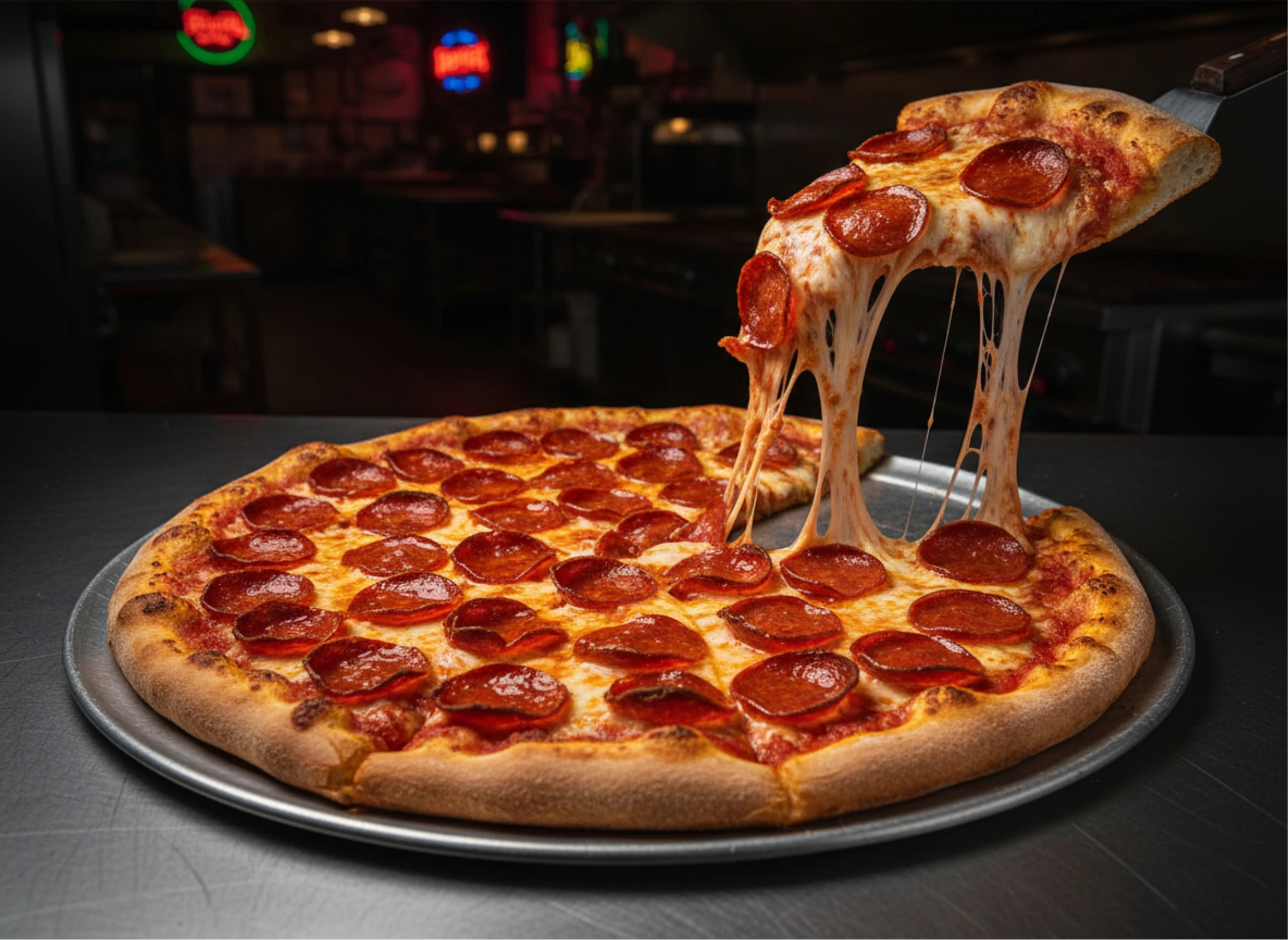
New York pizza is the most copied and most misunderstood style in America. Every city has a place that calls itself New York-style. Most of them are lying, not out of dishonesty but because they don’t understand what actually makes New York pizza what it is.
It’s not the sauce. It’s not the size. It’s not even the fold.
It’s the water. Or rather — it’s a specific combination of flour, fermentation, and bake that produces a crust with a particular chew and structure that’s hard to replicate unless you know what you’re after.
Here’s what you’re after.
What New York Pizza Actually Is
New York-style is a large, hand-tossed pie with a thin but substantial crust. The center is thin enough to fold — New Yorkers fold their slices lengthwise to eat them, which concentrates the toppings and makes them easier to manage while walking. The edge, the cornicione, has more structure than Neapolitan — it’s chewier, puffier, and often with some bubble char but nothing like Neapolitan leoparding.
The crust texture is the defining characteristic: a specific combination of crisp on the outside, chewy on the inside, with a satisfying pull when you bite through it. Not cracker-thin, not bread-thick — somewhere in between, with a structure that holds up under the weight of sauce, cheese, and toppings without flopping immediately.
The cheese is low-moisture whole-milk mozzarella. Not fresh, not part-skim. The fat content matters — it’s what gives you the characteristic orange grease pooling under the toppings, which is not a flaw. It’s a feature.
The sauce is simple and savory. Crushed tomatoes, olive oil, garlic, dried oregano. Cooked or uncooked depending on the pizzeria. Applied thin.
The New York Water Myth
New York pizza has a persistent myth attached to it: that the water in New York City is uniquely suited to making great pizza, and that you can’t replicate it elsewhere. This is mostly not true.
NYC water is soft — low in minerals — which does affect gluten development slightly. But controlled experiments have shown that filtering water to reduce mineral content produces results indistinguishable from NYC tap. The differences are real but minor.
The bigger factors are flour protein content, hydration, fermentation time, and bake temperature. These you can control completely regardless of where you live.
What Defines the Dough
Flour: High-gluten flour, 13-14% protein. King Arthur bread flour works. Some purists use All Trumps or similar high-gluten flour. The high protein content is what gives New York crust its characteristic chew — the strong gluten network resists tearing even when stretched large and thin.
Hydration: 58-63%. Lower than Neapolitan, higher than tavern-style. The moderate hydration produces a dough that’s workable and holds its shape when stretched thin.
Oil: Most New York doughs include a small amount of oil (1-2%). This tenderizes the crust slightly and helps it crisp in a deck oven. Without oil, the crust can be too tough.
Sugar: A small amount (1-2%) feeds the yeast and promotes browning. New York crust gets its golden-brown color partly from this.
Cold fermentation: The flavor in a good New York slice comes from a long, slow cold ferment — 24-72 hours minimum. Room temp shortcuts produce a bland crust. The cold retards yeast activity while allowing enzymatic breakdown to develop flavor compounds. This is the most important thing most home bakers skip.
The Bake
New York pizzerias use deck ovens — stone or tile surfaces at 500-600°F with lots of ambient heat in the chamber. A baking steel at home, preheated for 45+ minutes at your oven’s maximum temperature, gets you closest.
The target bake time is 10-14 minutes. You’re looking for an evenly golden bottom, slight char on the cheese, and a cornicione that’s puffed and spotted.
New York pizza is not flash-baked like Neapolitan. It bakes at lower heat for longer, which dries out the crust differently — you get crispness through moisture evaporation rather than char. The result is a crust that’s crisp when it comes out and stays workable as it cools, rather than a Neapolitan that needs to be eaten in the first three minutes.
Sizing and Stretching
New York pizzas are large — 16-18 inches for a full pie. At home, most people cap out at 14-16 inches, limited by oven size and steel size. Stretch the dough to the largest size you can manage while keeping even thickness.
The classic stretch technique: press from the center outward, leaving a thicker border. Then use knuckles under the dough to let gravity stretch it. Rotate while stretching. You’re working against the dough’s elasticity — take your time, and if it springs back, give it 10 minutes to relax.
What Most Home Versions Get Wrong
The three most common mistakes: not enough fermentation time, baking at too low a temperature, and using part-skim mozzarella. Part-skim has less fat and different melting behavior — you won’t get the same stretch or the characteristic appearance.
The fix is simple: plan your fermentation 24-48 hours ahead, preheat your steel as long as possible, and use whole-milk low-moisture mozzarella.
The Pie Lab’s New York preset gives you the exact hydration, flour weight, oil and sugar percentages for your batch. The scheduler handles fermentation timing so you’re not doing math at 11pm the night before pizza night.
Try it free at pielab.app — 14 days, no card, no account.