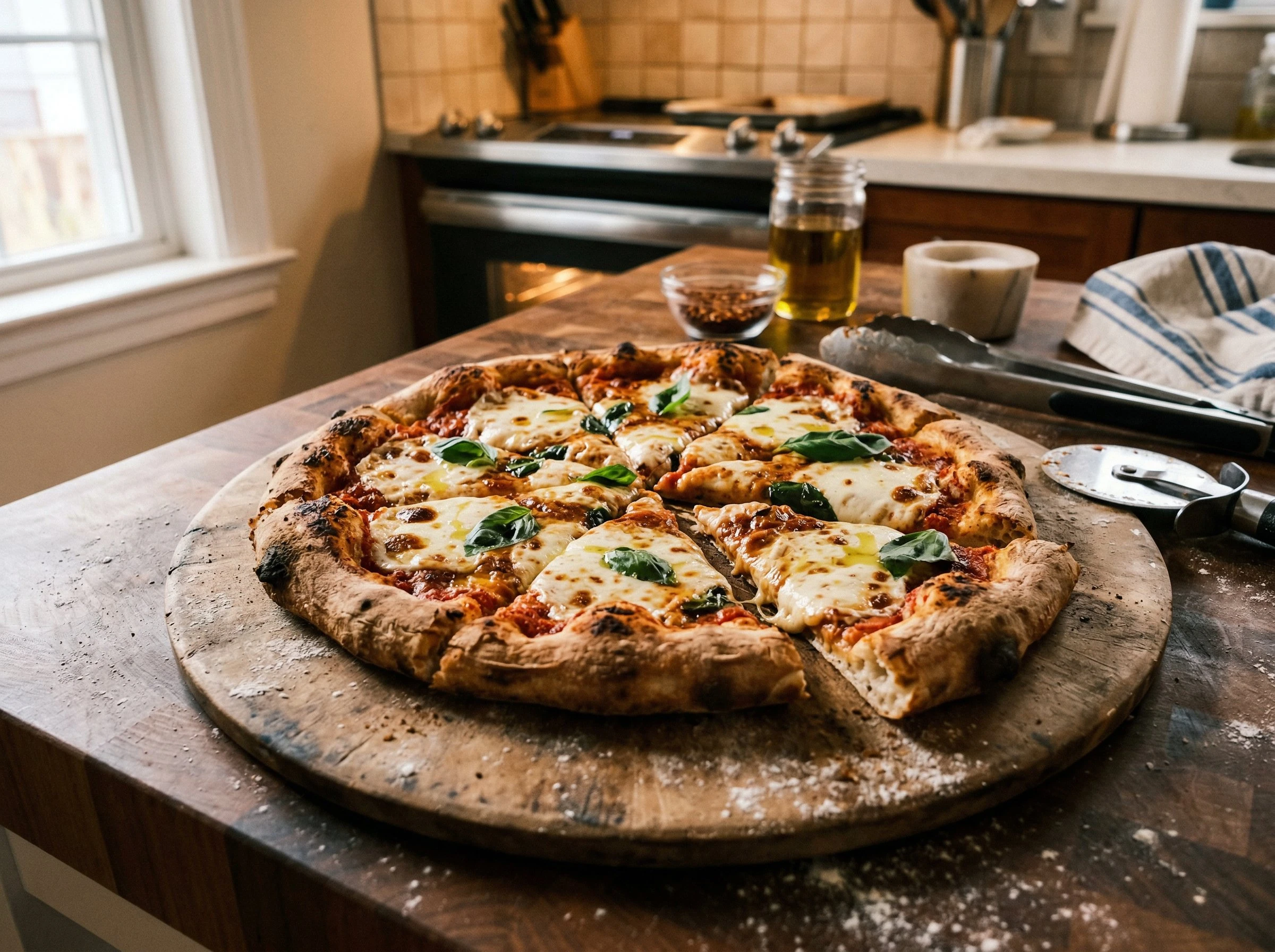
Most people ruin their first homemade pizza for the same two reasons: they used a recipe from a random website that gave cup measurements instead of weights, and they baked it on a cold sheet pan in an oven that wasn't hot enough.
Neither of these is your fault. Most beginner pizza content is bad.
This guide is different. It's honest about what matters, what doesn't, and how to get a result you're proud of on the first try.
What You Actually Need
Before the recipe, the equipment. You don't need a wood-fired oven. You don't need a KitchenAid mixer. You don't need pizza flour from Italy.
You need three things:
A kitchen scale. This is non-negotiable. Pizza dough is about ratios, and ratios require weight, not volume. A cup of flour can vary by 30% depending on how you scoop it. A kitchen scale removes that variable entirely. They cost $10-15 and they change everything.A baking steel or stone. A sheet pan will not give you a good result. It doesn't conduct heat properly and you'll end up with a soft, pale bottom crust. A baking steel ($40-60) or baking stone ($25-40) preheats in the oven and transfers heat directly to the dough the moment it lands. This is what creates the crust texture you're after.
An oven thermometer. Optional but useful. Many home ovens run 25-50°F cooler than their display reads. If your pizza keeps coming out pale and undercooked, this is probably why.
The Beginner's Dough
This is a New York-style dough — moderate hydration, forgiving, holds its shape well. Good for beginners because it's workable and the result is familiar.
For two 12-inch pizzas:
- Bread flour: 500g
- Water: 310g (62% hydration)
- Salt: 10g (2%)
- Instant yeast: 2g (0.4%)
- Olive oil: 10g (2%)
Mix flour and salt together. Add water and yeast, mix until no dry flour remains. Add olive oil, mix until incorporated. The dough will be shaggy. Cover it and let it rest 20 minutes — this rest (called autolyse) develops gluten without any kneading.
After the rest, knead for 5-6 minutes until smooth. Divide into two equal balls. Place each in a lightly oiled container, cover tightly, and refrigerate for 24-48 hours.
That's it. The refrigerator does the work.
The Day Of
Take the dough out of the fridge 1.5-2 hours before you want to bake. Cold dough is stiff and tears when you stretch it. Room temperature dough stretches easily.
Preheat your oven to its maximum temperature (usually 500-550°F) with the steel or stone inside. Give it at least 45 minutes to fully preheat — this is not optional. The steel needs to be fully saturated with heat or the bottom crust won't cook properly.
Stretching the Dough
On a lightly floured surface, press the dough ball into a flat disc with your fingers. Work from the center outward, leaving a thicker border around the edge. Don't use a rolling pin — it presses out the gas bubbles that make the crust light.
Once you have a flat disc, drape it over both fists and let gravity stretch it. Rotate it as you go. If it tears, patch it with your fingers and let it rest 5 minutes before continuing. If it keeps shrinking back, it's not relaxed yet — cover it and wait 10 minutes.
Aim for 12 inches. Don't worry if it's not perfectly round.
Toppings
Less is more. Beginner mistake: loading the pizza with every topping available. Heavy pizzas bake unevenly, the bottom doesn't crisp, and the toppings steam instead of roast.
Sauce: 3-4 tablespoons, spread thin. Cheese: 4-5 oz low-moisture mozzarella, shredded or sliced. Two additional toppings maximum. Pre-cook any vegetables — raw vegetables release water and make the pizza soggy.
The Bake
Launch the pizza onto the steel. Bake for 10-14 minutes. When the edges are spotted with char, the cheese is bubbling and beginning to brown, and the bottom is deeply golden, it's done.
Pull it out, let it rest 2 minutes before cutting. The cheese needs to set slightly or it all slides off.
What to Write Down
After your first bake, write down three things: what the dough felt like when you stretched it, what the bottom looked like when you pulled it, and what you'd change. These notes are worth more than any recipe.
The Pie Lab's bake journal does this automatically — log your dough specs, your bake details, and a photo. Over time you build a record of exactly what produced your best results.
Try it free at pielab.app — 14 days, no card, no account.