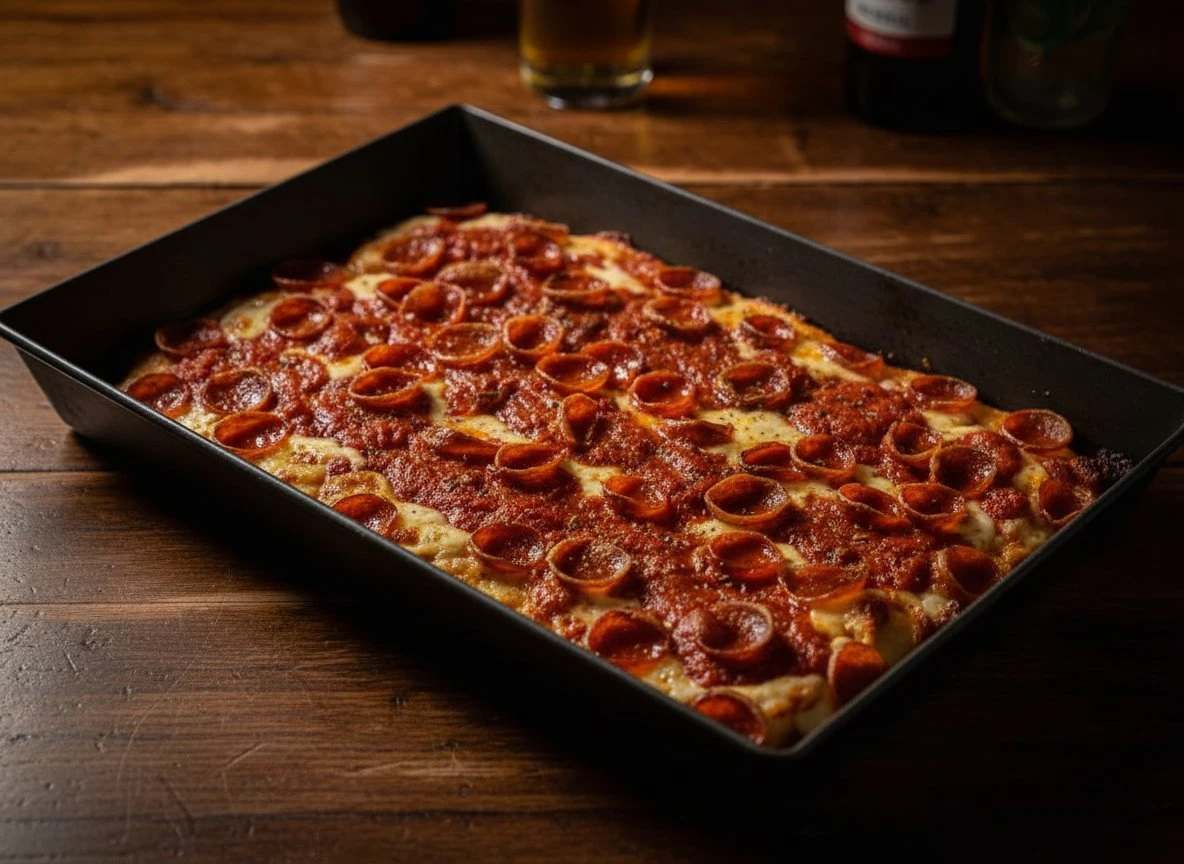
Detroit pizza spent 60 years being a local secret. You had to live there, or know someone who lived there, or stumble into Buddy's Pizza on a Tuesday to understand what it was. It wasn’t written about. It wasn’t on menus outside Michigan. It just existed — thick, rectangular, brick cheese, lacey fried edges — quietly being the best pizza most people had never heard of.
Then food media found it. Vice did a piece. Then Eater. Then every pizza-curious New Yorker wanted to know what this rectangular thing was. By the early 2020s, Detroit-style pizzerias were opening in Manhattan, Los Angeles, and Austin. The underground went mainstream.
For home bakers, Detroit is one of the most achievable high-reward styles there is. Here’s why, and how to do it right.
Where It Comes From
Buddy’s Pizza in Detroit, 1946. The original pan was a repurposed steel tray from an automotive parts supplier — the kind used to hold small components on factory floors. The thick gauge steel conducted heat differently than a standard baking pan, creating the bottom fry that defines the style.
The cheese used was Wisconsin brick cheese — a semi-soft, high-fat cheese with a mild, buttery flavor and excellent melt. It goes edge to edge, all the way to the rim of the pan, so when it hits the hot steel it fries and caramelizes into a crispy, lacey border. That border — called the \"frico edge\" — is the signature of authentic Detroit-style.
Sauce goes on top. Not under the cheese — on top, after it comes out of the oven, in thick racing stripes down the length of the pie. This keeps the sauce fresh and the cheese properly caramelized.
What Defines the Style
The pan. Rectangular, typically 10x14 inches. Steel or aluminum, well-seasoned. The pan shape isn’t aesthetic — it’s functional. The depth and material determine how the bottom cooks.
The frico edge. Cheese pressed to the rim, fried against the hot pan. When you cut a piece, the edge should be caramelized, slightly crispy, and deeply savory. If you don’t have it, you haven’t made Detroit-style — you’ve made a thick rectangular pizza.
The crumb. Airy, open, with large irregular holes. Detroit dough is a high-hydration focaccia-style dough. The fermentation is what creates the crumb structure — the longer and colder the ferment, the more developed the bubbles. A good slice has a bottom crust that’s fried and crispy, a soft open interior, and a top that’s just barely crisped from the oven.
Brick cheese. Wisconsin brick cheese is the authentic choice. It’s not always easy to find outside the Midwest, but a 50/50 blend of low-moisture mozzarella and white cheddar gets you close. The key is the fat content and the way it melts — you want a cheese that flows to the edge and stays there.
Sauce on top. After baking. Two or three thick stripes running lengthwise. San Marzano or quality crushed tomatoes, cooked down, lightly seasoned. It should be concentrated, not watery.
Why Detroit Is One of the Most Forgiving Styles at Home
High-hydration doughs are normally tricky to handle — they’re slack, sticky, and hard to shape. Detroit sidesteps this entirely because you never shape the dough. You mix it, let it ferment, dump it in the pan, and let it spread on its own. There’s no shaping skill required.
The pan does the work. You oil it generously, the dough relaxes into it over 1-2 hours, and you press it to the edges when it’s ready. That’s it.
The bake is also forgiving. You’re cooking at 450-500°F in a pan, not launching off a peel into a 900°F oven. You can check it, rotate it, pull it when it looks right. The steel pan acts as its own heat conductor.
The main place people go wrong: not giving the dough enough time, and skimping on the pan preparation. Both are fixable.
The Variables That Matter
Hydration (70-75%): Detroit dough is significantly wetter than most pizza doughs. This is what creates the open crumb. You can’t achieve that texture at lower hydration. Weigh your ingredients — you can’t measure 73% hydration accurately with cups.
Pan preparation: Use oil, not spray. Coat the pan generously — you want a puddle of oil in the bottom, not a film. This is what fries the bottom crust. Cheap pizza comes from under-oiled pans.
Fermentation time: Room temp for 2-3 hours works for same-day Detroit. A 24-48 hour cold ferment makes a better pizza — the flavor develops and the crumb structure improves. Cold ferment is highly recommended.
Cheese placement: To the edge. Press it into the corners. Don’t leave a border. The frico edge comes from cheese contact with the hot pan — if your cheese stops an inch from the edge, you don’t get it.
Bake sequence: Some recipes do a partial bake to set the crust, then add cheese, then finish. Others do full cheese from the start. Both work. The partial bake method gives you more control over the frico without risking overbrowning the cheese.
Tracking Your Detroit Bakes
Detroit is a style where tracking pays dividends fast because the variables compound. A 48-hour ferment versus a 24-hour ferment produces a noticeably different crumb. An extra tablespoon of oil in the pan changes the bottom texture. Getting the cheese to the exact edge of the pan versus leaving a small border changes the experience of eating the slice.
If you’re not writing these things down, you’re relying on memory, and memory is unreliable.
The Pie Lab’s Detroit preset calculates your dough at the right hydration with exact gram measurements. The scheduler builds your fermentation timeline backward from dinner. The journal stores your notes and photos so you can see what changed between bakes.
The app is $9.99, works offline, no account needed. Try everything free for 14 days at pielab.app.