Most home pizza bakers eventually hit a ceiling. They’ve been making good pizza for a year or two, they have a recipe they like, and they make it the same way every time. The ceiling is that they can’t adapt.
They want to make six pizzas for a party instead of two. They can’t scale. They want to try a wetter dough. They don’t know how much water to add. They read a recipe that calls for “73% hydration” and they have no idea what that means in cups.
Baker’s percentages are the system that removes this ceiling. Once you understand them, you can read any professional pizza recipe, scale any dough to any batch size, and design your own recipe from the ground up. Here’s how.
The System
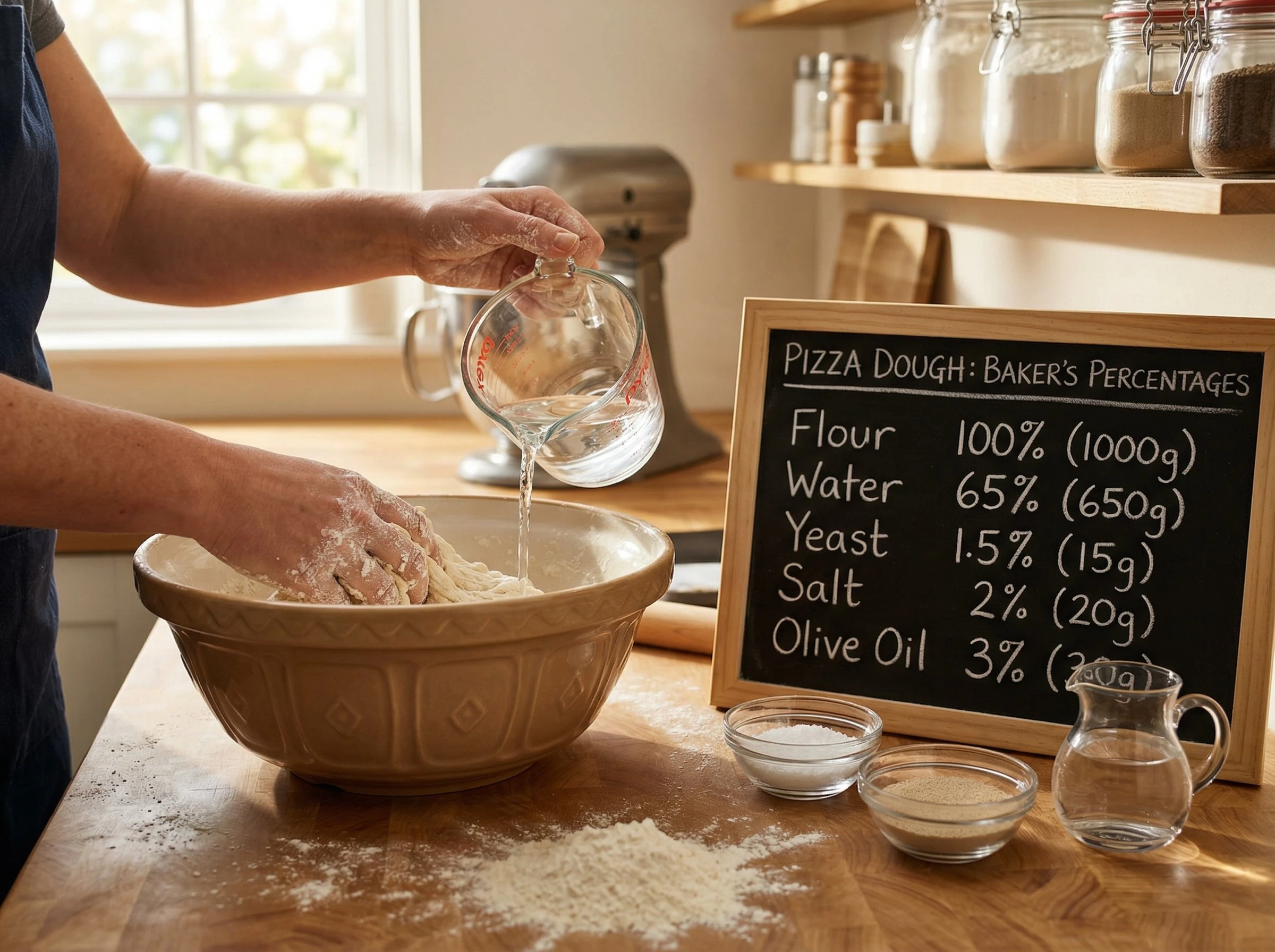
In baker’s percentages, flour is always 100%. Every other ingredient is expressed as a percentage of the flour weight.
This means:
- If flour is 500g and hydration is 65%, water is 325g.
- If flour is 1000g and hydration is 65%, water is 650g.
- The percentage is constant. The gram amount scales.
A complete New York-style formula:
- Flour: 100% (500g)
- Water: 62% (310g)
- Salt: 2% (10g)
- Instant yeast: 0.4% (2g)
- Oil: 2% (10g)
To make this dough for 8 pizzas instead of 4, double every gram amount. The percentages don’t change.
How to Scale for Any Number of Pizzas
Start by deciding your target dough ball weight. For a 12-inch New York pizza, 280g is a standard dough ball. For a 14-inch, 330g.
Calculate total dough weight needed: number of pizzas × dough ball weight + 5% extra for waste.
For 4 pizzas at 280g: 4 × 280 = 1120g + 56g waste = 1176g total dough.
Now calculate flour needed. This requires dividing by the sum of all percentages as a decimal:
Sum = 1.00 + 0.62 + 0.02 + 0.004 + 0.02 = 1.664
Flour = 1176 ÷ 1.664 = 707g
Then calculate each ingredient:
- Water: 707 × 0.62 = 438g
- Salt: 707 × 0.02 = 14g
- Yeast: 707 × 0.004 = 2.8g → round to 3g
- Oil: 707 × 0.02 = 14g
This works for any number of pizzas at any size. The formula is always the same.
The Pie Lab handles this entire calculation automatically — enter your style, number of pizzas, and target dough ball weight, and it outputs exact grams for every ingredient. But understanding the math is what lets you verify it, adapt it, and troubleshoot it.
Designing Your Own Formula
Once you understand percentages, you can build a formula for any style. The process:
Choose your hydration: What texture do you want? Start with a reference point (Neapolitan is 60-65%, New York is 60-63%, Detroit is 70-75%) and adjust based on your results.Choose your salt: 2-2.5% for most styles. Lower and it tastes flat. Higher and fermentation slows.
Choose your yeast: Depends on fermentation method. 0.2-0.4% for 48-72 hour cold ferment. 0.6-0.8% for same-day room temp.
Choose your fats and sugars: Oil at 1-3% for styles that call for it. Sugar at 1-2% for New York (helps browning). Neapolitan uses neither or very small amounts.
Write the percentages down, do the scaling calculation, weigh everything carefully, and bake. Take notes. Adjust one variable at a time. This is how professional pizzaiolos develop their house dough, and there’s no reason home bakers can’t do the same.